HOME PAGE SovereigntyLibrary Go To Chapter Nine
"Within regions of similar moisture conditions, the organic matter content of soil . . . decreases from north to south. For each fall of 10° C (18° F) in annual temperature the average organic matter content of soil increases two or three times, provided that [soil moisture] is kept constant."
Moist soil during the growing season encourages plantgrowth and thus organic matter production. Where the soil becomes dry during thegrowing season, plant growth slows or stops. So, all things being equal, wet soilscontain more organic matter than dry ones. All organic matter eventually rots, evenin soil too dry to grow plants. The higher the soil temperature the faster the decomposition.But chilly (not frozen) soils can still grow a lot of biomass. So, all things beingequal, hot soils have less humus in them than cold ones. Cool, wet soils will havethe highest levels; hot, dry soils will be lowest in humus.
This model checks out in practice. If we were to measureorganic matter in soils along the Mississippi River where soil moisture conditionsremain pretty similar from south to north, we might find 2 percent in sultry Arkansas,3 percent in Missouri and over 4 percent in Wisconsin, where soil temperatures aremuch lower. In Arizona, unirrigated desert soils have virtually no organic matter.In central and southern California where skimpy and undependable winter rains peterout by March, it is hard to find an unirrigated soil containing as much as 1 percentorganic matter while in the cool Maritime northwest, reliable winter rains keep thesoil damp into June and the more fertile farm pastures or natural prairies may developas much as 5 percent organic matter.
Other factors, like the basic mineral content of the soilor its texture, also influence the amount of organic matter a spot will create andwill somewhat increase or decrease the humus content compared to neighboring locationsexperiencing the same climate. But the most powerfully controlling influences aremoisture and temperature.
On all virgin soils the organic matter content naturallysustains itself at the highest possible level. And, average annual additions exactlymatch the average annual amount of decomposition. Think about that for a moment.Imagine that we start out with a plot of finely-ground rock particles containingno life and no organic matter. As the rock dust is colonized by life forms that graduallybuild in numbers it becomes soil. The organic matter created there increases nutrientavailability and accelerates the breakdown of rock particles, further increasingthe creation of organic matter. Soil humus steadily increases. Eventually a climaxis sustained where there is as much humus in the soil as there can be.
The peak plant and soil ecology that naturally lives on anysite is usually very healthy and is inevitably just as abundant as there is moistureand soil minerals to support it. To me this suggests how much organic matter it takesto grow a great vegetable garden. My theory is that in terms of soil organic matter,vegetables grow quite well at the humus level that would peak naturally on a virginsite. In semi-arid areas I'd modify the theory to include an increase as a resultof necessary irrigation. Expressed as a rough rule of thumb, a mere 2 percent organicmatter in hot climates increasing to 5 percent in cool ones will supply sufficientbiological soil activities to grow healthy vegetables if the mineral nutrientlevels are high enough too.
Recall my assertion that what is most important about organicmatter is not how much is present, but how much is lost each year through decomposition.For only by decomposing does organic matter release the nutrients it contains soplants can uptake them; only by being consumed does humus support the microecologythat so markedly contributes phytamins to plant nutrition, aggressively breaks downrock particles and releases the plant nutrients they contain; only by being eatendoes soil organic matter support bacteria and earthworms that improve productivityand create better tilth.
Here's something I find very interesting. Temperate climateshaving seasons and winter, vary greatly in average temperature. Comparing annualdecomposition loss from a hot soil carrying 2 percent humus with annual decompositionloss from a cooler soil carrying 5 percent, roughly the same amount of organic matterwill decay out of each soil during the growing season. This means that in temperateregions we have to replace about the same amount of organic matter no matter whatthe location.
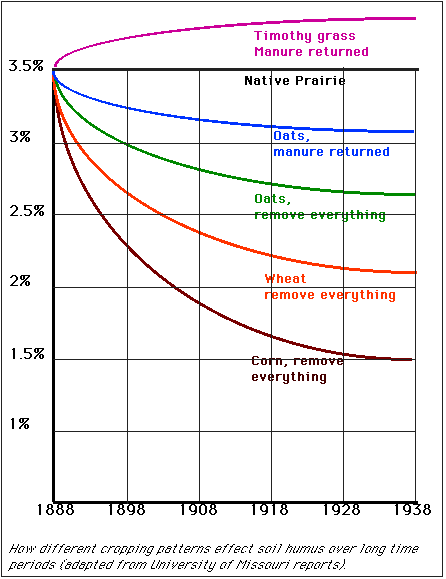
Like other substantial colleges of agriculture, the Universityof Missouri ran some very valuable long-term studies in soil management. In 1888,a never-farmed field of native prairie grasses was converted into test plots. Forfifty succeeding years each plot was managed in a different but consistent manner.The series of experiments that I find the most helpful recorded what happens to soilorganic matter as a consequence of farming practices. The virgin prairie had sustainedan organic matter content of about 3.5 percent. The lines on the graph show whathappened to that organic matter over time.
Timothy grass is probably a slightly more efficient converterof solar energy into organic matter than was the original prairie. After fifty yearsof feeding the hay cut from the field and returning all of the livestock's manure,the organic matter in the soil increased about 1/2 percent. Obviously, green manuringhas very limited ability to increase soil humus above climax levels. Growing oatsand returning enough manure to represent the straw and grain fed to livestock, thefield held its organic matter relatively constant.
Growing small grain and removing everything but the stubblefor fifty years greatly reduced the organic matter. Keep in mind that half the biomassproduction in a field happens below ground as roots. And keep in mind that the chartsdon't reveal the sad appearance the crops probably had once the organic matter declinedsignificantly. Nor do they show that the seed produced on those degenerated fieldsprobably would no longer sprout well enough to be used as seedgrain, so new seedwould have been imported into the system each season, bringing with it new suppliesof plant nutrients. Without importing that bushel or so of wheat seed on each acreeach year, the curves would have been steeper and gone even lower.
Corn is the hardest of the cereals on soil humus. The reasonis, wheat is closely broadcast in fall and makes a thick grassy overwintering standthat forms biomass out of most of the solar energy striking the field from springuntil early summer when the seed forms. Leafy oats create a little more biomass thanwheat. Corn, on the other hand, is frost tender and can't be planted early. It isalso not closely planted but is sown in widely-spaced rows. Corn takes quite a whilebefore it forms a leaf canopy that uses all available solar energy. In farming lingo,corn is a "row crop."
Vegetables are also row crops. Many types don't form densecanopies that soak up all solar energy for the entire growing season like a virginprairie. As with corn, the ground is tilled bare, so for much of the best part ofthe growing season little or no organic matter is produced. Of all the crops thata person can grow, vegetables are the hardest on soil organic matter. There is noway that vegetables can maintain soil humus, even if all their residues are religiouslycomposted and returned. Soil organic matter would decline markedly even in an experimentin which we raised some small animals exclusively on the vegetables and returnedall of their manure and urine too.
When growing vegetables we have to restore organic matterbeyond the amount the garden itself produces. The curves showing humus decline atthe University of Missouri give us a good hint as to how much organic matter we aregoing to lose from vegetable gardening. Let's make the most pessimistic possibleestimate and suppose that vegetable gardening is twice as hard on soil as was growingcorn and removing everything but the stubble and root systems.
With corn, about 40 percent of the entire organic matterreserve is depleted in the first ten years. Let's suppose that vegetables might removealmost all soil humus in ten years, or 10 percent each year for the firstfew years. This number is a crude. and for most places in America, a wildly pessimisticguess.
However, 10 percent loss per year may understate losses insome places. I have seen old row crop soils in California's central valley that looklike white-colored blowing dust. Nor does a 10 percent per year estimate quite allowfor the surprising durability I observe in the still black and rich-looking old vegetableseed fields of western Washington State's Skaget Valley. These cool-climate fieldshave suffered chemical farming for decades without having been completely destroyed--yet.
How much loss is 10 percent per year? Let's take my own gardenfor example. It started out as an old hay pasture that hadn't seen a plow for twenty-fiveor more years and where, for the five years I've owned the property, the annual grassproduction is not cut, baled, and sold but is cut and allowed to lie in place. Eachyear's accumulation of minerals and humus contributes to the better growth of thenext year's grass. Initially, my grass had grown a little higher and a little thickereach year. But the steady increase in biomass production seems to have tapered offin the last couple of years. I suppose by now the soil's organic matter content probablyhas been restored and is about 5 percent.
I allocate about one acre of that old pasture to garden land.In any given year my shifting gardens occupy one-third of that acre. The other two-thirdsare being regenerated in healing grass. I measure my garden in fractions of acres.Most city folks have little concept of an acre; its about 40,000 square feet, ora plot 200' x 200'.
Give or take some, the plow pan of an acre weighs about twomillion pounds. The plow pan is that seven inches of topsoil that is flipped overby a moldboard plow, the seven inches where most biological activity occurs, wherevirtually all of the soil's organic matter resides. Two million pounds equals onethousand tons of topsoil in the first seven inches of an acre. Five percent of thatone thousand tons can be organic matter, up to fifty priceless tons of life thatchanges 950 tons of dead dust into a fertile, productive acre. If 10 percent of thatfifty tons is lost as a consequence of one year's vegetable gardening, that amountsto five tons per acre per year lost or about 25 pounds lost per 100 square feet.
Patience, reader. There is a very blunt and soon to be avery obvious point to all of this arithmetic. Visualize this! Lime is spread at ratesup to four tons per acre. Have you ever spread 1 T/A or 50 pounds of lime over agarden 33 x 33 feet? Mighty hard to accomplish! Even 200 pounds of lime would barelywhiten the ground of a 1,000 square-foot garden. It is even harder to spread a mere5 tons of compost over an acre or only 25 pounds on a 100-square-foot bed. It seemsas though nothing has been accomplished, most of the soil still shows, there is nolayer of compost, only a thin scattering.
But for the purpose of maintaining humus content of vegetableground at a healthy level, a thin scattering once a year is a gracious plenty. Evenif I were starting with a totally depleted, dusty, absolutely humusless, ruined oldfarm field that had no organic matter whatsoever and I wanted to convert it to ahealthy vegetable garden, I would only have to make a one-time amendment of 50 tonsof ripe compost per acre or 2,500 pounds per 1,000 square feet. Now 2,500 poundsof humus is a groaning, spring-sagging, long-bed pickup load of compost heaped upabove the cab and dripping off the sides. Spread on a small garden, that's enoughto feel a sense of accomplishment about. Before I knew better I used to incorporatethat much composted horse manure once or twice a year and when I did add a half-inchthick layer that's about what I was applying.
Fertilizing Vegetables with Compost
Will a five ton per acre addition of compost provide enoughnutrition to grow great vegetables? Unfortunately, the answer usually is no. In mostgardens, in most climates, with most of what passes for "compost," it probablywon't. That much compost might well grow decent wheat.
The factors involved in making this statement are numerousand too complex to fully analyze in a little book like this one. They include theintrinsic mineralization of the soil itself, the temperature of the soil during thegrowing season, and the high nutritional needs of the vegetables themselves. In myexperience, a few alluvial soils that get regular, small additions of organic mattercan grow good vegetable crops without additional help. However, these sites are regularlyflooded and replenished with highly mineralized rock particles. Additionally, theymust become very warm during the growing season. But not all rock particles containhigh levels of plant nutrients and not all soils get hot enough to rapidly breakdown soil particles.
Soil temperature has a great deal to do with how effectivelycompost can act as fertilizer. Sandy soils warm up much faster in spring and sandallows for a much freer movement of air, so humus decomposes much more rapidly insand. Perhaps a sunny, sandy garden on a south-facing slope might grow pretty wellwith small amounts of strong compost. As a practical matter, if most people spreadeven the most potent compost over their gardens at only twenty-five pounds per 100square feet, they would almost certainly be disappointed.
Well then, if five tons of quality compost to the acre isn'tadequate for most vegetables, what about using ten or twenty tons of the best. Willthat grow a good garden? Again, the answer must allow for a lot of factors but isgenerally more positive. If the compost has a low C/N and that compost, or the soilitself, isn't grossly deficient in some essential nutrient, and if the soil has acoarse, airy texture that promotes decomposition, then somewhat heavier applicationswill grow a good-looking garden that yields a lot of food.
However, one question that is rarely asked and even morerarely answered satisfactorily in the holistic farming and gardening lore is: Preciselyhow much organic matter or humus is needed to maximize plant health and the nutritionalqualities of the food we're growing? An almost equally important corollary of thisis: Can there be too much organic matter?
This second question is not of practical consequence forbiological grain/livestock farmers because it is almost financially impossible toraise organic matter levels on farm soils to extraordinary amounts. Large-scale holisticfarmers must grow their own humus on their own farm. Their focus cannot be on buyingand bringing in large quantities of organic matter; it must be on conserving andmaximizing the value of the organic matter they produce themselves.
Where you do hear of an organic farmer (not vegetable growerbut cereal/livestock farmer) building extraordinary fertility by spreading largequantities of compost, remember that this farmer must be located near an inexpensivesource of quality material. If all the farmers wanted to do the same there wouldnot be enough to go around at an economic price unless, perhaps, the entire countrybecame a "closed system" like China. We would have to compost every bitof human excrement and organic matter and there still wouldn't be enough to meetthe demand. Even if we became as efficient as China, keep in mind the degraded stateof China's upland soils and the rapid desertification going on in their semi-aridwest. China is robbing Peter to pay Paul and may not have a truly sustainable agricultureeither.
I've frequently encountered a view among devotees of theorganic gardening movement that if a little organic matter is a good thing, thenmore must be better and even more better still. In Organic Gardening magazine andRodale garden books we read eulogies to soils that are so high in humus and so lacedwith earthworms that one can easily shove their arm into the soft earth elbow deepbut must yank it out fast before all the hairs have been chewed off by worms, whereone must jump away after planting corn seeds lest the stalk poke you in the eye,where the pumpkins average over 100 pounds each, where a single trellised tomatovine covers the entire south side of a house and yields bushels. All due to compost.
I call believers of the organic faith capital "O"organic gardeners. These folks almost inevitably have a pickup truck used to gatherin their neighborhood's leaves and grass clippings on trash day and to haul homeloads from local stables and chicken ranches. Their large yards are ringed with compostbins and their annual spreadings of compost are measured in multiples of inches.I was one once, myself.
There are two vital and slightly disrespectful questionsthat should be asked about this extreme of gardening practice. Is this much humusthe only way to grow big, high-yielding organic vegetable gardens and two, are vegetablesraised on soils super-high in humus maximally nutritious. If the answer to the firstquestion is no, then a person might avoid a lot of work by raising the nutrient levelof their soil in some other manner acceptable to the organic gardener. If the answerto the second question is less nutritious, then serious gardeners and homesteaderswho are making home-grown produce into a significant portion of their annual caloricintake had better reconsider their health assumptions. A lot of organic gardenerscherish ideas similar to the character Woody Allen played in his movie, Sleeper.
Do you recall that movie? It is about a contemporary Americanwho, coming unexpectedly close to death, is frozen and then reanimated and healed200 years in the future. However, our hero did not expect to die or be frozen whenhe became ill and upon awakening believes the explanation given to him is a put onand that his friends are conspiring to make him into a fool. The irritated doctorin charge tells Woody to snap out of it and be prepared to start a new life. Thisis no joke, says the doctor, all of Woody's friends are long since dead. Woody'sresponse is a classic line that earns me a few chuckles from the audience every timeI lecture: 'all my friends can't be dead! I owned a health food store and we allate brown rice.'
Humus and the Nutritional Quality of Food
I believe that the purpose of food is not merely to fillthe belly or to provide energy, but to create and maintain health. Ultimately, soilfertility should be evaluated not by humus content, nor microbial populations, norearthworm numbers, but by the long-term health consequences of eating the food. Ifphysical health degenerates, is maintained, or is improved we have measured the soil'strue worth. The technical name for this idea is a "biological assay." Evaluatingsoil fertility by biological assay is a very radical step, for connecting long-termchanges in health with the nutritional content of food and then with soil managementpractices invalidates a central tenet of industrial farming: that bulk yield is theultimate measure of success or failure. As Newman Turner, an English dairy farmerand disciple of Sir Albert Howard, put it:
"The orthodox scientist normally measures the fertility of a soil by its bulk yield, with no relation to effect on the ultimate consumer.
I have seen cattle slowly lose condition and fall in milk yield when fed entirely on the abundant produce of an apparently fertile soil. Though the soil was capable of yielding heavy crops, those crops were not adequate in themselves to maintain body weight and milk production in the cow, without supplements. That soil, though capable of above-average yields, and by the orthodox quantitative measure regarded as fertile, could not, by the more complete measure of ultimate effect on the consumer, be regarded but anything but deficient in fertility.
Fertility therefore, is the ability to produce at the highest recognized level of yield, crops of quality which, when consumed over long periods by animals or man, enable them to sustain health, bodily condition and high level of production without evidence of disease or deficiency of any kind.
Fertility cannot be measured quantitatively. Any measure of soil fertility must be related to the quality of its produce. . . . the most simple measure of soil fertility is its ability to transmit, through its produce, fertility to the ultimate consumer."
Howard also tells of creating a super-healthy herd ofwork oxen on his research farm at Indore, India. After a few years of meticulouscomposting and restoration of soil life, Howard's oxen glowed with well-being. Asa demonstration he intentionally allowed his animals to rub noses across the fencewith neighboring oxen known to be infected with hoof and mouth and other cattle plagues.His animals remained healthy. I have read so many similar accounts in the literatureof the organic farming movement that in my mind there is no denying the relationshipbetween the nutritional quality of plants and the presence of organic matter in soil.Many other organic gardeners reach the same conclusion. But most gardeners do notunderstand one critical difference between farming and gardening: most agriculturalradicals start farming on run-down land grossly deficient in organic matter. Theplant and animal health improvements they describe come from restoration of soilbalance, from approaching a climax humus level much like I've done in my pastureby no longer removing the grass.
But home gardeners and market gardeners near cities are ableto get their hands on virtually unlimited quantities of organic matter. Encouragedby a mistaken belief that the more organic matter the healthier, they enrich theirsoil far beyond any natural capacity. Often this is called "building up thesoil." But increasing organic matter in gardens well above a climax ecologylevel does not further increase the nutritional value of vegetables and in many circumstanceswill decrease their value markedly.
For many years I have lectured on organic gardening to theExtension Service's master gardener classes. Part of the master gardener trainingincludes interpreting soil test results. In the early 1980s when Oregon State governmenthad more money, all master gardener trainees were given a free soil test of theirown garden. Inevitably, an older gentlemen would come up after my lecture and askmy interpretation of his puzzling soil test.
Ladies, please excuse me. Lecturing in this era of women'slib I've broken my politically incorrect habit of saying "the gardener, he .. ." but in this case it was always a man, an organic gardener who hadbeen building up his soil for years.
The average soils in our region test moderately- to stronglyacid; are low in nitrogen, phosphorus, calcium, and magnesium; quite adequate inpotassium; and have 3-4 percent organic matter. Mr. Organic's soil test showed anorganic matter content of 15 to 20 percent with more than adequate nitrogen and apH of 7.2. However there was virtually no phosphorus, calcium or magnesium and fourtimes the amount of potassium that any farm agent would ever recommend. On the bottomof the test, always written in red ink, underlined, with three exclamation points,"No more wood ashes for five years!!!" Because so many people in the Maritimenorthwest heat with firewood, the soil tester had mistakenly assumed that the soilbecame alkaline and developed such a potassium imbalance from heavy applicationsof wood ashes.
This puzzled gardener couldn't grasp two things about hissoil test report. One, he did not use wood ashes and had no wood stove and two, althoughhe had been "building up his soil for six or seven years," the garden didnot grow as well as he had imagined it would. Perhaps you see why this questionerwas always a man. Mr. Organic owned a pickup and loved to haul organic matter andto make and spread compost. His soil was full of worms and had a remarkably highhumus level but still did not grow great crops.
It was actually worse than he understood. Plants uptake asmuch potassium as there is available in the soil, and concentrate that potassiumin their top growth. So when vegetation is hauled in and composted or when animalmanure is imported, large quantities of potassium come along with them. As will beexplained shortly, vegetation from forested regions like western Oregon is even morepotassium-rich and contains less of other vital nutrients than vegetation from otherareas. By covering his soil several inches thick with manure and compost every yearhe had totally saturated the earth with potassium. Its cation exchange capacity orin non-technical language, the soil's ability to hold other nutrients had been overwhelmedwith potassium and all phosphorus, calcium, magnesium, and other nutrients had largelybeen washed away by rain. It was even worse than that! The nutritional quality ofthe vegetables grown on that superhumusy soil was very, very low and would have beenfar higher had he used tiny amounts of compost and, horror of all horrors, chemicalfertilizer.
Climate and the Nutritional Quality of Food
Over geologic time spans, water passing through soil leachesor removes plant nutrients. In climates where there is barely enough rain to growcereal crops, soils retain their minerals and the food produced there tends to behighly nutritious. In verdant, rainy climates the soil is leached of plant nutrientsand the food grown there is much less nutritious. That's why the great healthy herdsof animals were found on scrubby, semi-arid grasslands like the American prairies;in comparison, lush forests carry far lower quantities of animal biomass.
Some plant nutrients are much more easily leached out thanothers. The first valuable mineral to go is calcium. Semi-arid soils usually stillretain large quantities of calcium. The nutrient most resistant to leaching is potassium.Leached out forest soils usually still retain relatively large amounts of potassium.William Albrecht observed this data and connected with it a number of fairly obviousand vital changes in plant nutritional qualities that are caused by these differencesin soil fertility. However obvious they may be, Albrecht's work was not consideredpolitically correct by his peers or the interest groups that supported agriculturalresearch during the mid-twentieth century and his contributions have been largelyignored. Worse, his ideas did not quite fit with the ideological preconceptions ofJ.l. Rodale, so organic gardeners and farmers are also ignorant of Albrecht's wisdom.
Albrecht would probably have approved of the following chartthat expresses the essential qualities of dryland and humid soils.
| Plant Nutrient | Dryland Prairie Soil | Humid Forest Soil |
| nitrogen | high | low |
| phosphorus | high | low |
| potassium | high | moderately high |
| calcium | very high | low |
| pH | neutral | acid |
Dryland soils contain far higher levels of all minerals thanleached soils. But Albrecht speculated that the key difference between these soilsis the ratio of calcium to potassium. In dryland soils there is much morecalcium in the soil than there is potassium while in wetter soils there is as muchor more potassium than calcium. To test his theory he grew some soybeans in pots.One pot had soil with a high amount of calcium relative to the amount of potassium,imitating dryland prairie soil. The other pot had just as much calcium but had morepotassium, giving it a ratio similar to a high quality farm soil in the eastern UnitedStates. Both soils grew good-looking samples of soybean plants, but when they wereanalyzed for nutritional content they proved to be quite different.
| Soil | Yield | Calories | Protein | Calcium | Phosphorus | Potassium |
| Humid | 17.8 gm | High | 13% | 0.27% | 0.14% | 2.15% |
| Dryland | 14.7 gm | Medium | 17% | 0.74% | 0.25% | 1.01% |
The potassium-fortified soil gave a 25 percent higher bulkyield but the soybeans contained 25 percent less protein. The consumer of those plantswould have to burn off approximately 30 percent more carbohydrates to obtain thesame amount of vital amino acids essential to all bodily functions. Wet-soil plantsalso contain only one-third as much calcium, an essential nutrient, whose lack overseveral generations causes gradual reduction of skeletal size and dental deterioration.They also contain only half as much phosphorus, another essential nutrient. Theiroversupply of potassium is not needed; humans eating balanced diets usually excretelarge quantities of unnecessary potassium in their urine.
Albrecht then analyzed dozens of samples of vegetation thatcame from both dryland soils and humid soils and noticed differences in them similarto the soybeans grown under controlled conditions. The next chart, showing the averagecomposition of plant vegetation from the two different regions, is taken directlyfrom Albrecht's research. The figures are averages of large numbers of plant samples,including many different food crops from each climate.
| Nutrient | Dryland Soil | Humid Soil |
| Potassium | 2.44% | 1.27% |
| Calcium | 1.92% | 0.28% |
| Phosphorus | 0.78% | 0.42% |
| Total mineral nutrition | 5.14% | 1.97% |
| Ratio of Potassium to Calciuim | 1.20/1 | 4.50/1 |
Analyzed as a whole, these data tell us a great deal abouthow we should manage our soil to produce the most nutritious food and about the judicioususe of compost in the garden as well. I ask you to refer back to these three smallcharts as I point out a number of conclusions that can be drawn from them.
The basic nutritional problem that all animals have is notabout finding energy food, but how to intake enough vitamins, minerals and usableproteins. What limits our ability to intake nutrients is the amount of bulk we canprocess--or the number of calories in the food. With cows, for example, bulk is thelimiter. The cow will completely fill her digestive tract at all times and will processall the vegetation she can digest every day of her life. Her health depends on theamount of nutrition in that bulk. With humans, our modern lifestyle limits most ofus to consuming 1,500 to 1,800 calories a day. Our health depends on the amount ofnutrients coming along with those calories.
So I write the fundamental equation for human health as follows:
HEALTH = NUTRITION IN FOOD DIVIDED BY CALORIES IN THAT FOOD
If the food that we eat contains all of the nutrients thatfood could possibly contain, and in the right ratios, then we will get sufficientnutrition while consuming the calories we need to supply energy. However, to thedegree that our diet contains denatured food supplying too much energy, we will belacking nutrition and our bodies will suffer gradual degeneration. This is why foodssuch as sugar and fat are less healthful because they are concentrated sources ofenergy that contain little or no nutrition. Nutritionless food also contributes to"hidden hungers" since the organism craves something that is missing. Thebody overeats, and becomes fat and unhealthy.
Albrecht's charts show us that food from dry climates tendsto be high in proteins and essential minerals while simultaneously lower in calories.Food from wet climates tends to be higher in calories while much lower in proteinand essential mineral nutrients. Albrecht's writings, as well as those of WestonPrice, and Sir Robert McCarrison listed in the bibliography, are full of examplesshowing how human health and longevity are directly associated with these same variationsin climate, soil, and food nutrition.
Albrecht pointed out a clear example of soil fertility causinghealth or sickness. In 1940, when America was preparing for World War II, all eligiblemen were called in for a physical examination to determine fitness for military service.At that time, Americans did not eat the same way we do now. Food was produced anddistributed locally. Bread was milled from local flour. Meat and milk came from localfarmers. Vegetables and potatoes did not all come from California. Regional differencesin soil fertility could be seen reflected in the health of people.
Albrecht's state, Missouri, is divided into a number of distinctrainfall regions. The northwestern part is grassy prairie and receives much lessmoisture than the humid, forested southeastern section. If soil tests were comparedacross a diagonal line drawn from the northwest to the southeast, they would exactlymimic the climate-caused mineral profile differences Albrecht had identified. Notunexpectedly, 200 young men per 1,000 draftees were medically unfit for militaryservice from the northwest part of Missouri while 400 per 1,000 were unfit from thesoutheastern part. And 300 per 1,000 were unfit from the center of the state.
Another interesting, and rather frightening, conclusion canbe drawn from the second chart. Please notice that by increasing the amount of potassiumin the potting soil, Albrecht increased the overall yield by 25 percent while simultaneouslylowering all of the other significant nutritional aspects. Most of this increaseof yield was in the form of carbohydrates, that in a food crops equates to calories.Agronomists also know that adding potassium fertilizer greatly and inexpensivelyincreases yield. So American farm soils are routinely dosed with potassium fertilizer,increasing bulk yield and profits without consideration for nutrition, or for theultimate costs in public health. Organic farmers often do not understand this aspectof plant nutrition either and may use "organic" forms of potassium to increasetheir yields and profits. Buying organically grown food is no guarantee that it containsthe ultimate in nutrition.
So, if health comes from paying attention to the ratio ofnutrition to calories in our food, then as gardeners who are in charge of creatinga significant amount of our own fodder, we can take that equation a step further:
| HEALTH | = | Nutrition/Calories | = | Calcium/Potassium |
When we decide how to manage our gardens we can take stepsto imitate dryland soils by keeping potassium levels lower while maintaining higherlevels of calcium.
Now take another close look at the thirdchart. Average vegetation from dryland soils contains slightly more potassiumthan calcium (1.2:1) while average vegetation from wetland soils contains many moretimes more potassium than calcium (4.5:1). When we import manure or vegetation intoour garden or farm soils we are adding large quantities of potassium. Those of usliving in rainy climates that were naturally forested have it much worse in thisrespect than those of us gardening on the prairies or growing irrigated gardens indesert climates because the very vegetation and manure we use to "build up"our gardens contains much more potassium while most of our soils already containall we need and then some.
It should be clear to you now why some organic gardenersreceive the soil tests like the man at my lecture. Even the soil tester, althoughscientifically trained and university educated, did not appreciate the actual sourceof the potassium overdose. The tester concluded it must have been wood ashes whenactually the potassium came from organic matter itself.
I conclude that organic matter is somewhat dangerous stuffwhose use should be limited to the amount needed to maintain basic soil tilth anda healthy, complex soil ecology.
Fertilizing Gardens Organically
Scientists analyzing the connections between soil fertilityand the nutritional value of crops have repeatedly remarked that the best crops aregrown with compost and fertilizer. Not fertilizer alone and not compost alone. Thebest place for gardeners to see these data is Werner Schupan's book (listed in thebibliography).
But say the word "fertilizer" to an organic gardenerand you'll usually raise their hackles. Actually there is no direct linkage of thewords "fertilizer" and "chemical." A fertilizer is any concentratedplant nutrient source that rapidly becomes available in the soil. In my opinion,chemicals are the poorest fertilizers; organic fertilizers are far superior.
The very first fertilizer sold widely in the industrial worldwas guano. It is the naturally sun-dried droppings of nesting sea birds that accumulatesin thick layers on rocky islands off the coast of South America. Guano is a potentnutrient source similar to dried chicken manure, containing large quantities of nitrogen,fair amounts of phosphorus, and smaller quantities of potassium. Guano is more potentthan any other manure because sea birds eat ocean fish, a very high protein and highlymineralized food. Other potent organic fertilizers include seed meals; pure, driedchicken manure; slaughterhouse wastes; dried kelp and other seaweeds; and fish meal.
| Material | % Nitrogen | % Phos. | % Potassium |
| Alfalfa meal | 2.5 | 0.5 | 2.1 |
| Bone meal (raw) | 3.5 | 21.0 | 0.2 |
| Bone meal (steamed) | 2.0 | 21.0 | 0.2 |
| Chicken manure (pure, fresh) | 2.6 | 1.25 | 0.75 |
| Cottonseed meal | 7.0 | 3.0 | 2.0 |
| Blood meal | 12.0 | 3.0 | -- |
| Fish meal | 8.0 | 7.0 | -- |
| Greensand | -- | 1.5 | 7.0 |
| Hoof and Horn | 12.5 | 2.0 | -- |
| Kelp meal | 1.5 | 0.75 | 4.9 |
| Peanut meal | 3.6 | 0.7 | 0.5 |
| Tankage | 11.0 | 5.0 | -- |
Growing most types of vegetables requires building a levelof soil fertility that is much higher than required by field crops like cereals,soybeans, cotton and sunflowers. Field crops can be acceptably productive on ordinarysoils without fertilization. However, because we have managed our farm soils as depreciatingindustrial assets rather than as relatively immortal living bodies, their abilityto deliver plant nutrients has declined and the average farmer usually must add additionalnutrients in the form of concentrated, rapidly-releasing fertilizers if they aregoing to grow a profitable crop.
Vegetables are much more demanding than field crops. Theyhave long been adapted to growing on potent composts or strong manures like freshhorse manure or chicken manure. Planted and nourished like wheat, most would refuseto grow or if they did survive in a wheat field, vegetables would not produce thesucculent, tender parts we consider valuable.
Building higher than normal levels of plant nutrients canbe done with large additions of potent compost and manure. In semi-arid parts ofthe country where vegetation holds a beneficial ratio of calcium to potassium foodgrown that way will be quite nutritious. In areas of heavier rainfall, increasingsoil fertility to vegetable levels is accomplished better with fertilizers. The datain the previous section gives strong reasons for many gardeners to limit the additionof organic matter in soil to a level that maintains a healthy soil ecology and acceptabletilth. Instead of supplementing compost with low quality chemical fertilizers, Irecommend making and using a complete organic fertilizer mix to increase mineralfertility.
|
|