HOME PAGE SovereigntyLibrary Go To Chapter Six
A note to the internet reader: In the the print-on-paper edition, this chapter and the next one on vermicomposting are full of illustrations showing composting structures and accessories. These do not reproduce well on-line and are not included.
Growing the majority of my family's food absorbs all of theenergy I care to put into gardening. So my yard is neat but shaggy. Motivated bywhat I consider total rationality, my lawn is cut only when it threatens to overwhelmthe lawnmower, and the lawn is not irrigated, so it browns off and stops growingin summer.
I don't grow flowers because I live on a river in a beautifulcountryside setting surrounded by low mountains. Nothing I created could begin tocompete with what nature freely offers my eye. One untidy bed of ornamentals by thefront door are my bow to conventionality, but these fit the entrances northeast aspectby being Oregon woods natives like ferns, salal, Oregon grape and an almost wildrhododendron--all these species thrive without irrigation.
When I give lectures, I am confronted by the amazing gardeningvariations that humans are capable of. Some folks' raised vegetable beds are crudelow mounds. Then, I am shown photographs of squared, paralleled vertical-walled raisedbeds, uniformly wrapped in cedar planks. Some gardens are planted in fairly straightrows, some are laid-out in carefully calculated interplanted hexagonal successionsand some are a wild scattering of catch-as-catch-can. Some people don't eat manykinds of vegetables yet grow large stands of corn and beans for canning or freezing.
Others grow small patches of a great many species, creatinga year-round gourmet produce stand for their personal enjoyment. Some gardeners growEnglish-style floral displays occupying every square inch of their yards and offeringa constant succession of color and texture.
This chapter presents some of the many different ways peoplehandle the disposal of yard and kitchen wastes. Compost making, like gardening, reflectsvariations in temperament. You probably weren't surprised at my casual landscapingbecause you already read about my unkempt compost heap. So I am similarly not surprisedto discover backyard composting methods as neat as a German village, as aestheticas a Japanese garden, as scientific as an engineer would design and as ugly as .. .
Containers and Other Similar Methods
In my days of youthful indiscretions I thought I could improvelife on Earth by civilizing high school youth through engendering in them an understandingof history. I confess I almost completely failed and gave up teaching after a fewyears. However, I personally learned a great deal about history and the telling ofhistory. I read many old journals, diaries, and travel accounts. From some of thesedocuments I gained little while other accounts introduced me to unique individualswho assisted me in understanding their era.
It seems that what differentiates good from bad reportingis how frank and honest the reporter is about their own personal opinions, prejudices,and outlooks. The more open and direct the reporter, the better the reader can discountinevitable distortions and get a picture of what might really have been there. Themore the reporter attempts to be "objective" by hiding their viewpoints,the less valuable their information.
That is why before discussing those manufactured aids tocomposting that can make a consumer of you, I want to inform you that I am a frugalperson who shuns unnecessary expenditure. I maintain what seems to me to be a perfectjustification for my stinginess: I prefer relative unemployment. Whenever I wantto buy something it has become my habit first to ask myself if the desired objectcould possibly bring me as much pleasure as knowing that I don't have to get up andgo to work the next morning. Usually I decide to save the money so I do not haveto earn more. En extremis, I repeat the old Yankee marching chant like a mantra:Make do! Wear it out! When it is gone, do without! Bum, Bum! Bum bi Dum! Bum bi diDum, Bum bi Dum!
So I do not own a shredder/grinder when patience will takeits place. I do not buy or make composting containers when a country life style andnot conforming to the neatness standards of others makes bins or tumblers unnecessary.However, I do grudgingly accept that others live differently. Let me warn you thatmy descriptions of composting aids and accessories are probably a little jaundiced.I am doing my best to be fair.
Visual appeal is the primary benefit of making compost ina container. To a tidy, northern European sense of order, any composting structurewill be far neater than the raw beauty of a naked heap. Composting container designsmay offer additional advantages but no single structure will do everything possible.With an enclosure, it may be possible to heat up a pile smaller than 1' x 4' x 4'because the walls and sometimes the top of the container may be insulating. Thisis a great advantage to someone with a postage stamp backyard that treasures everysquare foot. Similarly, wrapping the heap retards moisture loss. Some structuresshut out vermin.
On the other hand, structures can make it more difficultto make compost. Using a prefabricated bin can prevent a person from readily turningthe heap and can almost force a person to also buy some sort of shredder/chipperto first reduce the size of the material. Also, viewed as a depreciating economicasset with a limited life span, many composting aids cost as much or more money asthe value of all the material they can ever turn out. Financial cost relates to ecologicalcost, so spending money on short-lived plastic or easily rusted metal may negateany environmental benefit gained from recycling yard wastes.
Building Your Own Bin
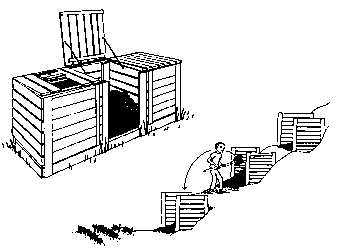
Probably the best homemade composting design is the multiplebin system where separate compartments facilitate continuous decomposition. Eachbin is about four feet on a side and three to four feet tall. Usually, the dividingwalls between bins are shared. Always, each bin opens completely at the front. Ithink the best design has removable slatted separators between a series of four (notthree) wooden bins in three declining sizes: two large, one medium-large and onesmaller. Alternatively, bins may be constructed of unmortared concrete blocks withremovable wooden fronts. Permanently constructed bins of mortared concrete blockor wood may have moisture-retentive, rain-protective hinged lids.
There are two workable composting systems that fit thesestructures. Most composters obtain materials too gradually to make a large heap allat once. In this case my suggestion is the four-bin system, using one large bin asa storage area for dry vegetation. Begin composting in bin two by mixing the drycontents temporarily stored in bin one with kitchen garbage, grass clippings andetc. Once bin two is filled and heating, remove its front slats and the side slatsseparating it from bin three and turn the pile into bin three, gradually reinsertingside slats as bin three is filled. Bin three, being about two-thirds the size ofbin two, will be filled to the brim. A new pile can be forming in bin two while binthree is cooking.
When bin three has settled significantly, repeat the process,turning bin three into bin four, etc. By the time the material has reheated in binfour and cooled you will have finished or close-to-finished compost At any pointduring this turning that resistant, unrotted material is discovered, instead of passingit on, it may be thrown back to an earlier bin to go through yet another decompositionstage. Perhaps the cleverest design of this type takes advantage of any significantslope or hill available to a lazy gardener and places a series of separate bins oneabove the next, eliminating any need for removable side-slats while making tossingcompost down to the next container relatively easy.
A simply constructed alternative avoids making removableslats between bins or of lifting the material over the walls to toss it from binto bin. Here, each bin is treated as a separate and discrete compost process. Whenit is time to turn the heap, the front is removed and the heap is turned right backinto its original container. To accomplish this it may be necessary to first shovelabout half of the material out of the bin onto a work area, then turn what is remainingin the bin and then cover it with what was shoveled out. Gradually the material inthe bin shrinks and decomposes. When finished, the compost will fill only a smallfraction of the bin's volume.
My clever students at the Urban Farm Class, University ofOregon have made a very inexpensive compost bin structure of this type using recycledindustrial wood pallets. They are held erect by nailing them to pressure-treatedfence posts sunk into the earth. The removable doors are also pallets, hooked onwith bailing wire. The flimsy pallets rot in a couple of years but obtaining morefree pallets is easy. If I were building a more finished three or four bin series,I would use rot-resistant wood like cedar and/or thoroughly paint the wood with anon-phytotoxic wood preservative like Cuprinol (copper napthanate). Cuprinol is notas permanent as other types of wood preservatives and may have to be reapplied everytwo or three years.
Bins reduce moisture loss and wood bins have the additionaladvantage of being fairly good thermal insulators: one inch of wood is as much insulationas one foot of solid concrete. Composting containers also have a potential disadvantage-reducingair flow, slowing decomposition, and possibly making the process go anaerobic. Shouldthis happen air flow can be improved by supporting the heap on a slatted floor madeof up-ended Cuprinol-treated 2 x 4's about three inches apart tacked into the backwall. Air ducts, inexpensively made from perforated plastic septic system leach line,are laid between the slats to greatly enhance air flow. I wouldn't initially builda bin array with ducted floors; these can be added as an afterthought if necessary.
Much simpler bins can be constructed out of 2" x 4"mesh x 36" or 48" high strong, welded wire fencing commonly called "turkeywire," or "hog wire." The fencing is formed into cylinders four tofive feet in diameter. I think a serious gardener might need one five-foot circleand two, four-foot diameter ones. Turkey wire is stiff enough to support itself whenformed into a circle by hooking the fencing upon itself. This home-rolled wire binsystem is the least expensive of all.
As compostable materials are available, the wire circle isgradually filled. Once the bin has been loaded and has settled somewhat, the wiremay be unhooked and peeled away; the material will hold itself in a cylindrical shapewithout further support. After a month or two the heap will have settled significantlyand will be ready to be turned into a smaller wire cylinder. Again, the materialis allowed to settle and then, if desired, the wire may be removed to be used againto form another neatly-shaped heap.
Wire-enclosed heaps encourage air circulation, but can alsoencourage drying out. Their proper location is in full shade. In hot, dry climates,moisture retention can be improved by wrapping a length of plastic sheeting aroundthe outside of the circle and if necessary, by draping another plastic sheet overthe top. However, doing this limits air flow and prevents removal of the wire supportYou may have to experiment with how much moisture-retention the heap can stand withoutgoing anaerobic. To calculate the length of wire (circumference) necessary to encloseany desired diameter, use the formula Circumference) = Diameter x 3.14. For example,to make a five-foot circle: 5 x 3.14 = approximately 16 feet of wire.
With the exception of the "tumbler," commerciallymade compost bins are derived from one of these two systems. Usually the factory-madewire bins are formed into rectangles instead of circles and may be made of PVC coatedsteel instead of galvanized wire. I see no advantage in buying a wire bin over makingone, other than supporting unnecessary stages of manufacture and distribution byspending more money. Turkey wire fencing is relatively inexpensive and easy enoughto find at farm supply and fencing stores. The last time I purchased any it was soldby the lineal foot much as hardware cloth is dispensed at hardware and building supplystores.
Manufactured solid-sided bins are usually constructed ofsheet steel or recycled plastic. In cool climates there is an advantage to tightlyconstructed plastic walls that retain heat and facilitate decomposition of smallerthermal masses. Precise construction also prevents access by larger vermin and pets.Mice, on the other hand, are capable of squeezing through amazingly small openings.Promotional materials make composting in pre-manufactured bins seem easy, self-righteouslyecological, and effortless. However, there are drawbacks.
It is not possible to readily turn the materials once they'vebeen placed into most composters of this type unless the entire front is removable.Instead, new materials are continuously placed on top while an opening at the bottompermits the gardener to scrape out finished compost in small quantities. Becauseno turning is involved, this method is called "passive" composting. Butto work well, the ingredients must not be too coarse and must be well mixed beforeloading.
Continuous bin composters generally work fast enough whenprocessing mixtures of readily decomposable materials like kitchen garbage,weeds, grass clippings and some leaves. But if the load contains too much fine grassor other gooey stuff and goes anaerobic, a special compost aerator must be used toloosen it up.
Manufactured passive composters are not very large. Compactnessmay be an advantage to people with very small yards or who may want to compost ontheir terrace or porch. But if the C/N of the materials is not favorable, decompositioncan take a long, long time and several bins may have to be used in tandem. Unlessthey are first ground or chopped very finely, larger more resistant materials likecorn, Brussels sprouts, sunflower stalks, cabbage stumps, shrub prunings, etc. will"constipate" a top-loading, bottom-discharging composter.
The compost tumbler is a clever method that accelerates decompositionby improving aeration and facilitating frequent turning. A rotating drum holdingfrom eight to eighteen bushels (the larger sizes look like a squat, fat, oversizedoil drum) is suspended above the ground, top-loaded with organic matter, and thentumbled every few days for a few weeks until the materials have decomposed. Thenthe door is opened and finished compost falls out the bottom.
Tumblers have real advantages. Frequent turning greatly increasesair supply and accelerates the process. Most tumblers retard moisture loss too becausethey are made of solid material, either heavy plastic or steel with small air vents.Being suspended above ground makes them immune to vermin and frequent turning makesit impossible for flies to breed.
Tumblers have disadvantages that may not become apparentuntil a person has used one for awhile. First, although greatly accelerated, compostingin them is not instantaneous. Passive bins are continuous processors while (withthe exception of one unique design) tumblers are "batch" processors, meaningthat they are first loaded and then the entire load is decomposed to finished compost.What does a person do with newly acquired kitchen garbage and other waste duringthe two to six weeks that they are tumbling a batch? One handy solution is to buytwo tumblers and be filling one while the other is working, but tumblers aren't cheap!The more substantial ones cost $250 to $400 plus freight.
There are other less obvious tumbler disadvantages that maynegate any work avoided, time saved, or sweaty turning with a manure fork eliminated.Being top-loaded means lifting compost materials and dropping them into a small openingthat may be shoulder height or more. These materials may include a sloppy bucketof kitchen garbage. Then, a tumbler must be tumbled for a few minutes everytwo or three days. Cranking the lever or grunting with the barrel may seem like funat first but it can get old fast. Decomposition in an untumbled tumbler slows downto a crawl.
Both the passive compost bin and the highly active composttumbler work much better when loaded with small-sized particles. The purchase ofeither one tends to impel the gardener to also buy something to cut and/or grindcompost materials.
The U.C. Method--Grinder/Shredders
During the 1950s, mainstream interest in municipal compostingdeveloped in America for the first time. Various industrial processes already existedin Europe; most of these were patented variations on large and expensive compostingtumblers. Researchers at the University of California set out to see if simpler methodscould be developed to handle urban organic wastes without investing in so much heavymachinery. Their best system, named the U. C. Fast Compost Method, rapidly made compostin about two weeks.
No claim was ever made that U. C. method produces the highestquality compost. The idea was to process and decompose organic matter as inoffensivelyand rapidly as possible. No attempt is made to maximize the product's C/N as is donein slower methods developed by Howard at Indore. Most municipal composting done inthis country today follows the basic process worked out by the University of California.
Speed of decomposition comes about from very high internalheat and extreme aerobic conditions. To achieve the highest possible temperature,all of the organic material to be composted is first passed through a grinder andthen stacked in a long, high windrow. Generally the height is about five to six feet,any higher causes too much compaction. Because the material is stacked with sidesas vertical as possible, the width takes care of itself.
Frequent turning with machinery keeps the heap working rapidly.During the initial experiments the turning was done with a tractor and front endloader. These days giant "U" shaped machines may roll down windrows atmunicipal composting plots, automatically turning, reshaping the windrow and if necessary,simultaneously spraying water.
Some municipal waste consists of moist kitchen garbage andgrass clippings. Most of the rest is dry paper. If this mixture results in a moisturecontent that is too high the pile gets soggy, sags promptly, and easily goes anaerobic.Turning not only restores aerobic conditions, but also tends to drop the moisturecontent. If the initial moisture content is between 60 and 70 percent, the windrowis turned every two days. Five such turns, starting two days after the windrow isfirst formed, finishes the processing. If the moisture content is between 10 and60 percent, the windrow is first turned after three days and thence at three dayintervals, taking about four turns to finish the process. If the moisture contentis below 40 percent or drops below 40 percent during processing, moisture is added.
No nuisances can develop if turning is done correctly. Simplyflipping the heap over or adding new material on top will not do it. The materialmust be blended so that the outsides are shifted to the core and the core becomesthe skin. This way, any fly larvae, pathogens, or insect eggs that might not be killedby the cooler temperatures on the outside are rotated into the lethal high heat ofthe core every few days.
The speed of the U.C. method also appeals to the backyardgardener. At home, frequent turning can be accomplished either in naked heaps, orby switching from one bin to the next and back, or with a compost tumbler. But achipper/shredder is also essential. Grinding everything that goes into the heap hasother advantages than higher heat and accelerated processing. Materials may be initiallymixed as they are ground and small particles are much easier to turn over than longtwigs, tough straw, and other fibrous materials that tie the heap together and makeit difficult to separate and handle with hand tools.
Backyard shredders have other uses, especially for gardenerswith no land to waste. Composting tough materials like grape prunings, berry canes,and hedge trimmings can take a long time. Slow heaps containing resistant materialsoccupy precious space. With a shredder you can fast-compost small limbs, tree prunings,and other woody materials like corn and sunflower stalks. Whole autumn leaves tendto compact into airless layers and decompose slowly, but dry leaves are among theeasiest of all materials to grind. Once smashed into flakes, leaves become a fluffymaterial that resists compaction.
Electric driven garden chipper/shredders are easier on theneighbors' ears than more powerful gasoline-powered machines, although not so quietthat I'd run one without ear protection. Electrics are light enough for a strongperson to pick up and carry out to the composting area and keep secured in a storeroom.One more plus, there never is any problem starting an electric motor. But no wayto conveniently repair one either.
There are two basic shredding systems. One is the hammermill--agrinding chamber containing a rotating spindle with steel tines or hammers attachedthat repeatedly beats and tears materials into smaller and smaller pieces until theyfall out through a bottom screen. Hammermills will flail almost anything to pieceswithout becoming dulled. Soft, green materials are beaten to shreds; hard, dry, brittlestuff is rapidly fractured into tiny chips. Changing the size of the discharge screenadjusts the size of the final product. By using very coarse screens, even soft, wet,stringy materials can be slowly fed through the grinding chamber without hopelesslytangling up in the hammers.
Like a coarse power planer in a wood shop, the other typeof machine uses sharpened blades that slice thin chips from whatever is pushed intoits maw. The chipper is designed to grind woody materials like small tree limbs,prunings, and berry canes. Proper functioning depends on having sharp blades. Butedges easily become dulled and require maintenance. Care must be taken to avoid passingsoil and small stones through a chipper. Soft, dry, brittle materials like leaveswill be broken up but aren't processed as rapidly as in a hammermill. Chippers won'thandle soft wet stuff.
When driven by low horsepower electric motors, both chippersand hammermills are light-duty machines. They may be a little shaky, standing onspindly legs or small platforms, so materials must be fed in gently. Most electricmodels cost between $300 and $400.
People with more than a postage-stamp yard who like dealingwith machinery may want a gasoline-powered shredder/chipper. These are much moresubstantial machines that combine both a big hammermill shredder with a side-feedingchipper for limbs and branches. Flailing within a hammermill or chipping limbs oftwo or more inches in diameter focuses a great deal of force; between the enginenoise and the deafening din as dry materials bang around the grinding chamber, earprotection is essential. So are safety goggles and heavy gloves. Even though thefan belt driving the spindle is shielded, I would not operate one without wearingtight-fitting clothes. When grinding dry materials, great clouds of dust may be givenoff. Some of these particles, like the dust from alfalfa or from dried-out spoiled(moldy) hay, can severely irritate lungs, eyes, throat and nasal passages. A facemask, or better, an army surplus gas mask with built-in goggles, may be in order.And you'll probably want to take a shower when finished.
Fitted with the right-size screen selected from the assortmentsupplied at purchase, something learned after a bit of experience, powerful hammermillsare capable of pulverizing fairly large amounts of dry material in short order. Butwet stuff is much slower to pass through and may take a much coarser screen to getout at all. Changing materials may mean changing screens and that takes a few minutes.Dry leaves seem to flow through as fast as they can be fed in. The side-feed auxiliarychippers incorporated into hammermills will make short work of smaller green treelimbs; but dry, hardened wood takes a lot longer. Feeding large hard branches toofast can tear up chipper blades and even break the ball-bearing housings holdingthe spindle. Here I speak from experience.
Though advertisements for these machines make them seem effortlessand fast, shredders actually take considerable time, energy, skilled attention, constantconcentration, and experience. When grinding one must attentively match the inflowto the rate of outflow because if the hopper is overfilled the tines become snarledand cease to work. For example, tangling easily can occur while rapidly feeding inthin brittle flakes of dry spoiled hay and then failing to slow down while a soft,wet flake is gradually reduced. To clear a snarled rotor without risking continuedattachment of one's own arm, the motor must be killed before reaching into the hopperand untangling the tines. To clear badly clogged machines it may also be necessaryto first remove and then replace the discharge screen, something that takes a fewminutes.
There are significant differences in the quality of materialsand workmanship that go into making these machines. They all look good when freshlypainted; it is not always possible to know what you have bought until a season ortwo of heavy use has passed. One tried-and-true aid to choosing quality is to askequipment rental businesses what brand their customers are not able to destroy. Anotherguide is to observe the brand of gasoline engine attached.
In my gardening career I've owned quite a few gas-poweredrotary tillers and lawnmowers and one eight-horsepower shredder. In my experiencethere are two grades of small gasoline engines--"consumer" and the genuine"industrial." Like all consumer merchandise, consumer-grade engines areintended to be consumed. They have a design life of a few hundred hours and thenare worn out. Most parts are made of soft, easily-machined aluminum, reinforced withsmall amounts of steel in vital places.
There are two genuinely superior American companies--Kohlerand Wisconsin-that make very durable, long-lasting gas engines commonly found onsmall industrial equipment. With proper maintenance their machines are designed toendure thousands of hours of continuous use. I believe small gas engines made byYamaha, Kawasaki, and especially Honda, are of equal or greater quality to anythingmade in America. I suggest you could do worse than to judge how long the maker expectstheir shredder/chipper to last by the motor it selects.
Gasoline-powered shredder/chippers cost from $700 to $1,300.Back in the early 1970s I wore one pretty well out in only one year of making fastcompost for a half-acre Biodynamic French intensive market garden. When I amortizedthe cost of the machine into the value of both the compost and the vegetables I grewwith the compost, and considered the amount of time I spent running the grinder againstthe extra energy it takes to turn ordinary slow compost heaps I decided I would bebetter off allowing my heaps to take more time to mature.
Sheet Composting
Decomposition happens rapidly in a hot compost heap withthe main agents of decay being heat-loving microorganisms. Decomposition happensslowly at the soil's surface with the main agents of decay being soil animals. However,if the leaves and forest duff on the floor of a forest or a thick matted sod aretilled into the topsoil, decomposition is greatly accelerated.
For two centuries, frontier American agriculture dependedon just such a method. Early pioneers would move into an untouched region, clearthe forest, and plow in millennia of accumulated nutrients held as biomass on theforest floor. For a few years, perhaps a decade, or even twenty years if the soilcarried a higher level of mineralization than the average, crops from forest soilsgrew magnificently. Then, unless other methods were introduced to rebuild fertility,yields, crop, animal, and human health all declined. When the less-leached grassyprairies of what we now call the Midwest were reached, even greater bounties weremined out for more years because rich black-soil grasslands contain more mineralnutrients and sod accumulates far more humus than do forests.
Sheet composting mimics this system while saving a greatdeal of effort. Instead of first heaping organic matter up, turning it several times,carting humus back to the garden, spreading it, and tilling it in, sheet compostingconducts the decomposition process with far less effort right in the soil needingenrichment.
Sheet composting is the easiest method of all. However, themethod has certain liabilities. Unless the material being spread is pure manure withoutsignificant amounts of bedding, or only fresh spring grass clippings, or alfalfahay, the carbon-nitrogen ratio will almost certainly be well above that of stablehumus. As explained earlier, during the initial stages of decay the soil will bethoroughly depleted of nutrients. Only after the surplus carbon has been consumedwill the soil ecology and nutrient profile normalize. The time this will take dependson the nature of the materials being composted and on soil conditions.
If the soil is moist, airy, and warm and if it already containedhigh levels of nutrients, and if the organic materials are not ligninous and toughand have a reasonable C/N, then sheet composting will proceed rapidly. If the soilis cold, dry, clayey (relatively airless) or infertile and/or the organic matterconsists of things like grain straw, paper, or the very worst, barkless sawdust,then decomposition will be slowed. Obviously, it is not possible to state with anyprecision how fast sheet composting would proceed for you.
Autumn leaves usually sheet compost very successfully. Theseare gathered, spread over all of the garden (except for those areas intended forearly spring sowing), and tilled in as shallowly as possible before winter. Evenin the North where soil freezes solid for months, some decomposition will occur inautumn and then in spring, as the soil warms, composting instantly resumes and isfinished by the time frost danger is over. Sheet composting higher C/N materialsin spring is also workable where the land is not scheduled for planting early. Ifthe organic matter has a low C/N, like manure, a tender green manure crop not yetforming seed, alfalfa hay or grass clippings, quite a large volume of material canbe decomposed by warm soil in a matter of weeks.
However, rotting large quantities of very resistant materiallike sawdust can take many months, even in hot, moist soil. Most gardeners cannotafford to give their valuable land over to being a compost factory for months. Oneway to speed the sheet composting of something with a high C/N is to amend it witha strong nitrogen source like chicken manure or seed meal. If sawdust is the onlyorganic matter you can find, I recommend an exception to avoiding chemical fertilizer.By adding about 80 pounds of urea to each cubic yard of sawdust, its overall C/Nis reduced from 500:1 to about 20:1. Urea is perhaps the most benign of all chemicalnitrogen sources. It does not acidify the soil, is not toxic to worms or other soilanimals or microorganisms, and is actually a synthetic form of the naturally occurringchemical that contains most of the nitrogen in animal urine. In that sense, puttingurea in soil is not that different than putting synthetic vitamin C in a human body
Burying kitchen garbage is a traditional form of sheet compostingpracticed by row-cropping gardeners usually in mild climates where the soil doesnot freeze in winter. Some people use a post hole digger to make a neat six- to eight-inchdiameter hole about eighteen inches deep between well-spaced growing rows of plants.When the hole has been filled to within two or three inches of the surface, it istopped off with soil. Rarely will animals molest buried garbage, it is safe fromflies and yet enough air exists in the soil for it to rapidly decompose. The localsoil ecology and nutrient balance is temporarily disrupted, but the upset only happensin this one little spot far enough away from growing plants to have no harmful effect.
Another garbage disposal variation has been called "trenchcomposting." Instead of a post hole, a long trench about the width of a combinationshovel and a foot deep is gradually dug between row crops spaced about four feet(or more) apart. As bucket after bucket of garbage, manure, and other organic matterare emptied into the trench, it is covered with soil dug from a little further along.Next year, the rows are shifted two feet over so that crops are sown above the compostedgarbage.
Mulch Gardening
Ruth Stout discovered--or at least popularized this new-to-hermethod. Mulching may owe some of its popularity to Ruth's possession of writing talentsimilar to her brother Rex's, who was a well-known mid- century mystery writer. Ruth'shumorous book, Gardening Without Work is a fun-to-read classic that I highlyrecommend if for no other reason than it shows how an intelligent person can makeremarkable discoveries simply by observing the obvious. However, like many othergarden writers, Ruth Stout made the mistake of assuming that what worked in her ownbackyard would be universally applicable. Mulch gardening does not succeed everywhere.
This easy method mimics decomposition on the forest floor.Instead of making compost heaps or sheet composting, the garden is kept thickly coveredwith a permanent layer of decomposing vegetation. Year-round mulch produces a numberof synergistic advantages. Decay on the soil's surface is slow but steady and maintainsfertility. As on the forest floor, soil animals and worm populations are high. Theiractivities continuously loosen the earth, steadily transport humus and nutrientsdeeper into the soil, and eliminate all need for tillage. Protected from the sun,the surface layers of soil do not dry out so shallow-feeding species like lettuceand moisture-lovers like radishes make much better growth. During high summer, mulchedground does not become unhealthfully heated up either.
The advantages go on. The very top layer of soil directlyunder the mulch has a high organic matter content, retaining moisture, eliminatingcrusting, and consequently, enhancing the germination of seeds. Mulchers usuallysow in well-separated rows. The gardener merely rakes back the mulch and exposesa few inches of bare soil, scratches a furrow, and covers the seed with humusy topsoil.As the seedlings grow taller and are thinned out, the mulch is gradually pushed backaround them.
Weeds? No problem! Except where germinating seeds, the mulchlayer is thick enough to prevent weed seeds from sprouting. Should a weed begin showingthrough the mulch, this is taken as an indication that spot has become too thinlycovered and a flake of spoiled hay or other vegetation is tossed on the unwantedplant, smothering it.
Oh, how easy it seems! Pick a garden site. If you have ayear to wait before starting your garden do not even bother to till first. Coverit a foot deep with combinations of spoiled hay, leaves, grass clippings, and straw.Woody wastes are not suitable because they won't rot fast enough to feed the soil.Kitchen garbage and manures can also be tossed on the earth and, for a sense of tidiness,covered with hay. The mulch smothers the grass or weeds growing there and the sitebegins to soften. Next year it will be ready to grow vegetables.
If the plot is very infertile to begin with there won't beenough biological activity or nutrients in the soil to rapidly decompose the mulch.In that case, to accelerate the process, before first putting down mulch till inan initial manure layer or a heavy sprinkling of seed meal. Forever after, mulchingmaterials alone will be sufficient. Never again till. Never again weed. Never againfertilize. No compost piles to make, turn, and haul. Just keep your eye open forspoiled hay and buy a few inexpensive tons of it each year.
Stout, who discovered mulch gardening in Connecticut whereirregular summer rains were usually sufficient to water a widely-spaced garden, alsomistakenly thought that mulched gardens lost less soil moisture because the earthwas protected from the drying sun and thus did not need irrigation through occasionaldrought. I suspect that drought resistance under mulch has more to do with a plant'sability to feed vigorously, obtain nutrition, and continue growing because the surfaceinches where most of soil nutrients and biological activities are located, stayedmoist. I also suspect that actual, measurable moisture loss from mulched soil maybe greater than from bare earth. But that's another book I wrote, called GardeningWithout Irrigation.
Yes, gardening under permanent year-round mulch seems easy,but it does have a few glitches. Ruth Stout did not discover them because she livedin Connecticut where the soil freezes solid every winter and stays frozen for longenough to set back population levels of certain soil animals. In the North, earwigsand sow bugs (pill bugs) are frequently found in mulched gardens but they do notbecome a serious pest. Slugs are infrequent and snails don't exist. All thanks towinter.
Try permanent mulch in the deep South, or California whereI was first disappointed with mulching, or the Maritime northwest where I now live,and a catastrophe develops. During the first year these soil animals are presentbut cause no problem. But after the first mild winter with no population setback,they become a plague. Slugs (and in California, snails) will be found everywhere,devastating seedlings. Earwigs and sow bugs, that previously only were seen eatingonly decaying mulch, begin to attack plants. It soon becomes impossible to get astand of seedlings established. The situation can be rapidly cured by raking up allthe mulch, carting it away from the garden, and composting it. I know this to bethe truth because I've had to do just that both in California where as a novice gardenerI had my first mulch catastrophes, and then when I moved to Oregon, I gave mulchinganother trial with similar sad results.
Sources for Composters, Grinders and etc.
Shredder/Chippers and other power equipment
I've been watching this market change rapidly since the early1970s. Manufacturers come and go. Equipment is usually ordered direct from the maker,freight extra. Those interested in large horsepower shredder/chippers might checkthe advertisements in garden-related magazines such as National Gardening, OrganicGardening, Sunset, Horticulture, Fine Gardening, Country Living (Harrowsmith), etc.Without intending any endorsement or criticism of their products, two makers thathave remained in business since I started gardening are:
Kemp Company. 160 Koser Road., Lititz, PA 17543. (also compostdrums)
Troy-Bilt Manufacturing Company, 102D St. & 9th Ave.,Troy, NY 12180
Mail-order catalog sources of compost containers and garden accessories
Gardens Alive, 5100 Schenley Place, Lawrenceburg, Indiana47025
Gardener's Supply Company, 128 Intervale Road, Burlington,VT 05401
Ringer Corporation, 9959 Valley View Road, Eden Prairie,MN 55344
Smith & Hawken, 25 Corte Madera, Mill Valley, CA 94941
HOME PAGE SovereigntyLibrary Go To Chapter Six