Sugar, manufactured by photosynthesis,is the simplest and most vital carbohydrate. Sugar is "burned" in all plantcells as the primary fuel powering all living activities. Extra sugar can be morecompactly stored after being converted into starches, which are long strings of sugarmolecules linked together. Plants often have starch-filled stems, roots, or tubers;they also make enzymes capable of quickly converting this starch back into sugarupon demand. We homebrewers and bakers make practical use of a similar enzyme processto change starches stored in grains back to sugar that yeasts can change into alcohol.
C/N of Various Tree Leaves/Needles False acacia 14:1 Fir 48:1 Black alder 15:1 Birch 50:1 Gray alder 19:1 Beech 51:1 Ash 21:1 Maple 52:1 Birds's eye cherry 22:1 Red oak 53:1 Hornbeam 23:1 Poplar 63:1 Elm 28:1 Pine 66:1 Lime 37:1 Douglas fir 77:1 Oak 47:1 Larch 113:1
The protein content of tree leaves is very similar to their ratio of carbon (C) compared to nitrogen (N)
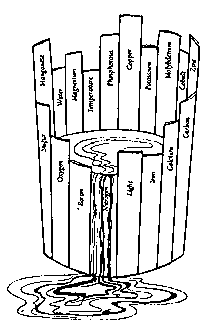
Liebig suggested imagining a barrel beingfilled with water as a metaphor for plant growth: the amount of water held in thebarrel being the amount of growth. Each stave represents one of the factors or requirementsplants need in order to grow such as light, water, oxygen, nitrogen, phosphorus,copper, boron, etc. Lowering any one stave of the barrel, no matter which one, lessensthe amount of water that can be held and thus growth is reduced to the level of themost limited growth factor. ±6:1 ±12:1 ±25:1 ±50:1 ±100:1
Sometimes plants store food in theform of oil, the most concentrated biological energy source. Oil is also constructedfrom sugar and is usually found in seeds. Plants also build structural materialslike stem, cell walls, and other woody parts from sugars converted into cellulose,a substance similar to starch. Very strong structures are constructed with lignins,a material like cellulose but much more durable. Cellulose and lignins are permanent.They cannot be converted back into sugar by plant enzymes. Nor can most animals orbacteria digest them.
Certain fungi can digest celluloseand lignin, as can the symbiotic bacteria inhabiting a cow's rumen. In this respectthe cow is a very clever animal running a cellulose digestion factory in the firstand largest of its several stomachs. There, it cultures bacteria that eat cellulose;then the cow digests the bacteria as they pass out of one stomach and into another.
Plants also construct proteins, thevital stuff of life itself. Proteins are mainly found in those parts of the plantinvolved with reproduction and photosynthesis. Protein molecules differ from starchesand sugars in that they are larger and amazingly more complex. Most significantly,while carbohydrates are mainly carbon and hydrogen, proteins contain large amountsof nitrogen and numerous other mineral nutrients.
Proteins are scarce in nature. Plantscan make them only in proportion to the amount of the nutrient, nitrogen, that theytake up from the soil. Most soils are very poorly endowed with nitrogen. If nitrate-poor,nutrient-poor soil is well-watered there may be lush vegetation but the plants willcontain little protein and can support few animals. But where there are high levelsof nutrients in the soil there will be large numbers of animals, even if the landis poorly watered and grows only scrubby grasses--verdant forests usually feed onlya few shy deer while the short grass semi-desert prairies once supported huge herdsof grazing animals.
Ironically, just as it is with carbon,there is no absolute shortage of nitrogen on Earth. The atmosphere is nearly 80 percentnitrogen. But in the form of gas, atmospheric nitrogen is completely useless to plantsor animals. It must first be combined chemically into forms plants can use, suchas nitrate (NO3) or ammonia (NH
Nitrogen gas strongly resists combiningwith other elements. Chemical factories fix nitrogen only at very high temperaturesand pressures and in the presence of exotic catalysts like platinum or by exposingnitrogen gas to powerful electric sparks. Lightning flashes can similarly fix smallamounts of nitrogen that fall to earth dissolved in rain.
And certain soil-dwelling microorganismsare able to fix atmospheric nitrogen. But these are abundant only where the earthis rich in humus and minerals, especially calcium. So in a soil body where largequantities of fixed nitrogen are naturally present, the soil will also be well-endowedwith a good supply of mineral nutrients.
Most of the world's supply of combinednitrogen is biologically fixed at normal temperatures and standard atmospheric pressureby soil microorganisms. We call the ones that live freely in soil "azobacteria"and the ones that associate themselves with the roots of legumes "rhizobia."Blue-green algae of the type that thrive in rice paddies also manufacture nitratenitrogen. We really don't know how bacteria accomplish this but the nitrogen they"fix" is the basis of most proteins on earth.
All microorganisms, including nitrogen-fixingbacteria, build their bodies from the very same elements that plants use for growth.Where these mineral elements are abundant in soil, the entire soil body is more aliveand carries much more biomass at all levels from bacteria through insects, plants,and even mammals.
Should any of these vital nutrientsubstances be in short supply, all biomass and plant growth will decrease to thelevel permitted by the amount available, even though there is an overabundance ofall the rest. The name for this phenomena is the "Law of Limiting Factors."The concept of limits was first formulated by a scientist, Justus von Liebig, inthe middle of the last century. Although Liebig's name is not popular with organicgardeners and farmers because misconceptions of his ideas have led to the widespreaduse of chemical fertilizers, Liebig's theory of limits is still good science.
For example, one essential plant proteinis called chlorophyll, the green pigment found in leaves that makes sugar throughphotosynthesis. Chlorophyll is a protein containing significant amounts of magnesium.Obviously, the plant's ability to grow is limited by its ability to find enough fixednitrogen and also magnesium to make this protein.
Animals of all sizes from elephantsto single cell microorganisms are primarily composed of protein. But the greatestportion of plant material is not protein, it is carbohydrates in one form or another.Eating enough carbohydrates to supply their energy requirements is rarely the survivalproblem faced by animals; finding enough protein (and other vital nutrients) in theirfood supply to grow and reproduce is what limits their population. The numbers andhealth of grazing animals is limited by the protein and other nutrient content ofthe grasses they are eating, similarly the numbers and health of primary decomposersliving on the forest floor is limited by the nutrient content of their food. Andso is the rate of decomposition. And so too is this true in the compost pile.
The protein content of vegetation isvery similar to its ratio of carbon (C) compared to nitrogen (N). Quick laboratoryanalysis of protein content is not done by measuring actual protein itself but bymeasuring the amount of combined nitrogen the protein gives off while decomposing.Acacia, alder, and leaves of other proteinaceous legumes such as locust, mesquite,scotch broom, vetch, alfalfa, beans, and peas have low C/N ratios because legumeroots uniquely can shelter clusters of nitrogen-fixing rhizobia. These microorganismscan supply all the nitrate nitrogen fast-growing legumes can use if the soil is alsowell endowed with other mineral nutrients rhizobia need, especially calcium and phosphorus.Most other plant families are entirely dependent on nitrate supplies presented tothem by the soil. Consequently, those regions or locations with soils deficient inmineral nutrients tend to grow coniferous forests while richer soils support forestswith more protein in their leaves. There may also be climatic conditions that favorconifers over deciduous trees, regardless of soil fertility.
It is generally true that organic matterwith a high ratio of carbon to nitrogen also will have a high ratio of carbon toother minerals. And low C/N materials will contain much larger amounts of other vitalmineral nutrients. When we make compost from a wide variety of materials there areprobably enough quantity and variety of nutrients in the plant residues to form largepopulations of humus-forming soil animals and microorganisms. However, when makingcompost primarily with high C/N stuff we need to blend in other substances containingsufficient fixed nitrogen and other vital nutrient minerals. Otherwise, the decompositionprocess will take a very long time because large numbers of decomposing organismswill not be able to develop.
Bone Meal Vegetables Summer grass cornstalks (dry) Sawdust Meat scraps Garden weeds Seaweed Straw (grain) Paper Fish waste Alfalfa hay Legume hulls Hay (low quality) Tree bark Rabbit manure Horse manure Fruit waste Bagasse Chicken manure Sewage sludge Hay (top quality) Grain chaff Pig manure Silage Corn cobs Seed meal Cow manure Cotton mill waste
The lists in this table of carbon/nitrogenratios are broken out as general ranges of C/N. It has long been an unintelligentpractice of garden-level books to state "precise" C/N ratios for materials.One substance will be "23:1" while another will be "25:1." Suchpseudoscience is not only inaccurate but it leads readers into similar misunderstandingsabout other such lists, like nitrogen contents, or composition breakdowns of organicmanures, or other organic soil amendments. Especially misleading are those tablesin the back of many health and nutrition books spelling out the "exact"nutrient contents of foods. There is an old saying about this: 'There are lies, thenthere are damned lies, and then, there are statistics. The worse lies of all canbe statistics.'
The composition of plant materialsis very dependent on the level and nature of the soil fertility that produced them.The nutrition present in two plants of the same species, even in two samples of theexact same variety of vegetable raised from the same packet of seed can vary enormouslydepending on where the plants were grown. William Albrecht, chairman of the SoilDepartment at the University of Missouri during the 1930s, was, to the best of myknowledge, the first mainstream scientist to thoroughly explore the differences inthe nutritional qualities of plants and to identify specific aspects of soil fertilityas the reason why one plant can be much more nutritious than another and why animalscan be so much healthier on one farm compared to another. By implication, Albrechtalso meant to show the reason why one nation of people can be much less healthy thananother. Because his holistic outlook ran counter to powerful vested interests ofhis era, Albrecht was professionally scorned and ultimately left the university community,spending the rest of his life educating the general public, especially farmers andhealth care professionals.
Summarized in one paragraph, Albrechtshowed that within a single species or variety, plant protein levels vary 25 percentor more depending on soil fertility, while a plant's content of vital nutrients likecalcium, magnesium, and phosphorus can simultaneously move up or down as much as300 percent, usually corresponding to similar changes in its protein level. Albrechtalso discovered how to manage soil in order to produce highly nutritious food. ChapterEight has a lot more praise for Dr. Albrecht. There I explore this interesting aspectof gardening in more detail because how we make and use organic matter has a greatdeal to do with the resulting nutritional quality of the food we grow.
Imagine trying to make compost fromdeficient materials such as a heap of pure, moist sawdust. What happens? Very littleand very, very slowly. Trees locate most of their nutrient accumulation in theirleaves to make protein for photosynthesis. A small amount goes into making bark.Wood itself is virtually pure cellulose, derived from air and water. If, when wefarmed trees, we removed only the wood and left the leaves and bark on the site,we would be removing next to nothing from the soil. If the sawdust comes from a lumbermill, as opposed to a cabinet shop, it may also contain some bark and consequentlysmall amounts of other essential nutrients.
Thoroughly moistened and heaped up,a sawdust pile would not heat up, only a few primary decomposers would take up residence.A person could wait five years for compost to form from pure moist sawdust and stillnot much would happen. Perhaps that's why the words "compost" and "compot"as the British mean it, are connected. In England, a compot is a slightly fermentedmixture of many things like fruits. If we mixed the sawdust with other materialshaving a very low C/N, then it would decompose, along with the other items.
HOME PAGE SovereigntyLibrary Go To Chapter Three